
The short answer: Between capitalism and socialism sits a third economic system, and the West already uses its core mechanic (profit-and-loss risk-sharing) in the one place it wants results: venture capital. Modern money is created as debt, so total debt must grow faster than the money supply, which makes the recurring crashes structural, not accidental. Islamic economics answers that with risk-sharing instead of interest, and a 2.5% levy on idle wealth (zakat) instead of income tax.
There is a number almost nobody wants you to sit with for too long. As of early 2024, total global debt crossed $315 trillion, roughly three times the entire planet’s annual economic output. Two-thirds of it sits not in the poor, “mismanaged” Global South, but in the advanced economies that lecture everyone else about fiscal discipline.
Here is the question that breaks the whole illusion: if the entire world is in debt, then to whom, exactly, does the world owe the money?
Hold that thought. Because the answer, and the system that produces it, is the reason I’m going to make a claim most people in finance will find either naive or heretical: capitalism, as a complete economic order, does not work. Not “needs reform.” Does not work. It is structurally rigged to concentrate wealth upward, manufacture recurring crises, and tax the people who work while the people who own defer, hoard, and compound.
And the alternative is not socialism, which fails for the opposite reason. The alternative is a third system that the West keeps re-inventing in pieces, in venture capital, in the resilience of Islamic banks, in every economist who quietly admits the money supply is just debt, without ever naming what it is.
It is the economic framework of the Qur’an. And this is the part they’d rather you didn’t think about too hard.
A note on what this argument is, and isn’t
Let me be precise, because precision is what makes a bold claim survive contact with a hostile reader.
I am not claiming that every state that flew an Islamic flag ran a flawless economy. They didn’t. I am not claiming Muslim-majority countries today are economic models. Most of them are visibly not.
I am claiming something narrower and far harder to refute: the economic principles expressed in the Qur’an and the prophetic tradition are sound, and nearly every failure attributed to “Islamic economics,” historical or modern, traces to the abandonment of those principles, usually under external pressure. Meanwhile, nearly every recurring failure of the Western system traces to institutionalizing their opposite.
No human-built economic model is ideal. The argument here is about which set of principles, when actually implemented, produces justice, stability, and broad prosperity, and which produces $315 trillion of debt and asks the working class to service it.
Part One: The disease has a name, and the Bank of England already described it
Strip away the jargon and modern money works like this: it is created as debt.
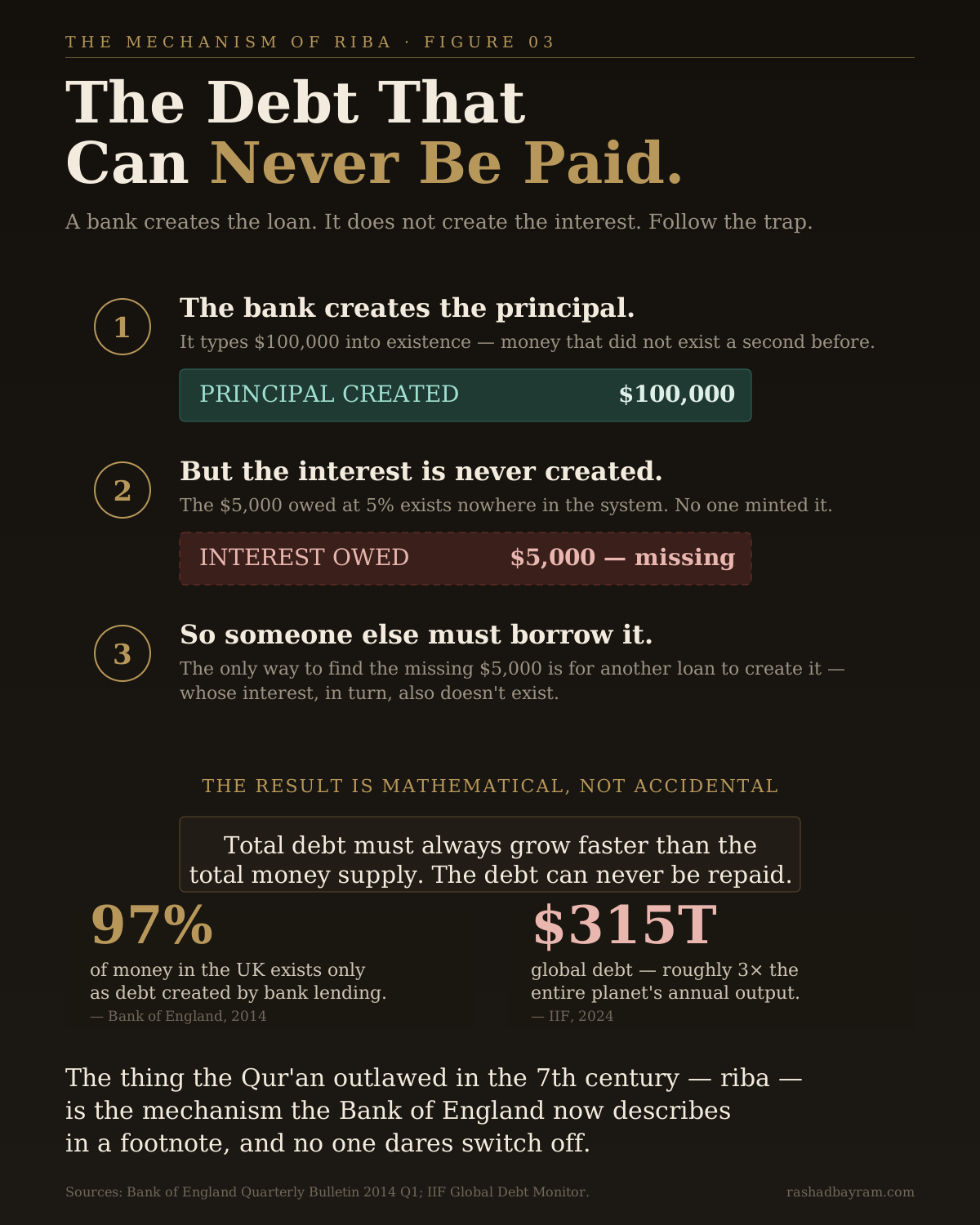
When a commercial bank issues a loan, it does not lend out someone else’s deposited savings. It creates new money, the principal, by typing it into existence on its own balance sheet. This is not a conspiracy theory. It is the Bank of England’s own description of how the system works, published in its 2014 Quarterly Bulletin: roughly 97% of money in circulation in the UK exists as bank deposits created through lending.
Now follow the trap. The bank creates the principal. It does not create the interest owed on that principal. If a bank conjures $100,000 at 5%, it creates the $100,000, but the $5,000 of annual interest does not exist anywhere in the system. It has to be earned by pulling money from somewhere else in the economy, which means someone else must borrow it into existence, which means their interest doesn’t exist either.
The result is mathematically inevitable: total debt must always grow faster than the total money supply. The system can never be paid off. It can only expand, borrowing to service borrowing, until it seizes. This is why we get “regular cycles of Great-Depression-like crashes.” They are not accidents or failures of regulation. They are the system operating exactly as designed.
And this is not fringe economics. Irving Fisher said it in 1935. Hyman Minsky built a career on it. A 2024 monetary model out of the University of Missouri shows fractional-reserve systems generate “endogenous cyclic, chaotic, and stochastic” instability, boom and bust written into the math.
There is one more turn of the screw. When new money is created, it does not arrive everywhere at once. It reaches the wealthy and well-connected first, the banks, the asset-holders, the borrowers with collateral, who buy assets and inflate their prices before the new money trickles down to wages. By the time it reaches the worker, prices have already risen. This is the Cantillon effect, and it is the quiet engine of modern inequality: a permanent, structural wealth transfer from those who earn to those who own.
Now you can answer the $315 trillion question. If everyone is a debtor, the creditor is whoever sits at the top of the money-creation hierarchy, the financial institutions and asset-holders to whom the interest perpetually flows upward. The debt is not a bug. The debt is the business model.
The thing the Qur’an prohibited in the seventh century, riba, the increase of money on money without risk or production, is the precise mechanism the Bank of England now describes in a footnote and no one has the nerve to switch off.
Ten questions to ask before the money moves
Real cases where the problem was not the one anyone named, the questions that would have caught them, and what a dodge sounds like. Free, and you join the weekly letter. Confirm the link I send and you are in. Unsubscribe any time.
Part Two: The two empires, same war, opposite fate
Here is where critics think they have me. “If Islamic economics is so superior,” they say, “explain the Ottoman bankruptcy of 1875. The caliphate went broke. Case closed.”
It is a serious-sounding objection that collapses the moment you read the actual history.
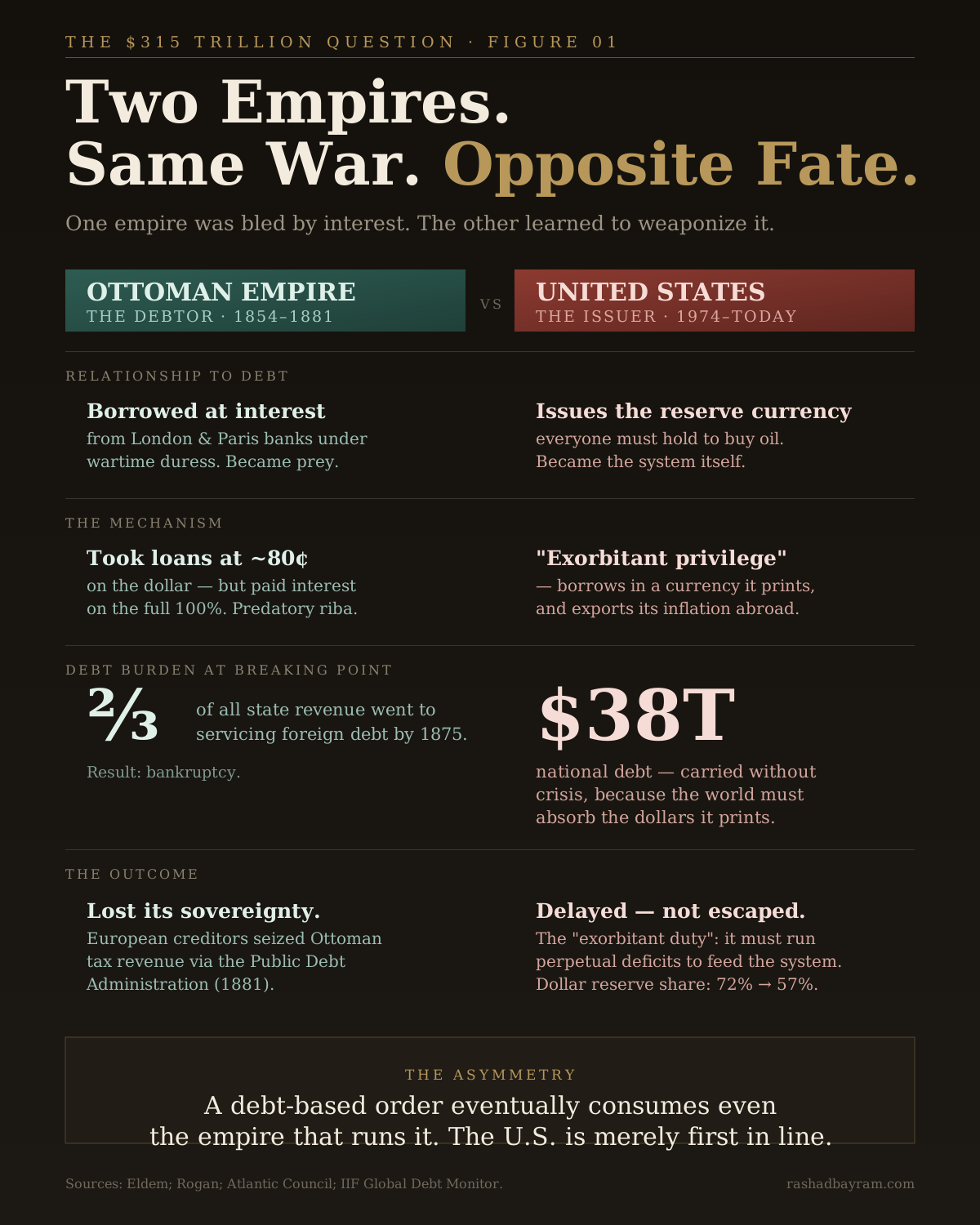
For most of its existence, the Ottoman Empire avoided external borrowing entirely, financing itself through internal revenue and institutional mechanisms like the waqf. The break came in 1854, during the Crimean War. Fighting Russia, the empire took its first foreign loan from London and Paris, and the terms tell you everything. The Ottomans received the loan at roughly 80% of face value but paid interest on the full 100%. That is riba in its most predatory form: a discount on the front end, full interest on the back.
From there it snowballed exactly as Part One predicts. Borrowing to service borrowing. By 1875, with the empire fighting on multiple fronts, Balkan insurrections, then a war with Russia, and crippled by drought and famine that gutted tax revenue, over half, then two-thirds, of all state revenue was going to service foreign debt. The empire defaulted. Six years later, European creditors installed the Ottoman Public Debt Administration, a body run by foreign bondholders that seized control of Ottoman tax streams, salt, tobacco, customs, and collected them before the Ottoman treasury saw a coin.
The historian Eugene Rogan put it exactly right: the single greatest threat to the independence of the Middle East in the nineteenth century “was not the armies of Europe but its banks.”
So read the Ottoman collapse again. It is not evidence against Islamic economics. It is a case study in what happens to a sovereign the moment it abandons the prohibition on riba and submits to interest-bearing debt. The Ottomans didn’t fall because of zakat. They fell because they took the West’s loans, on the West’s terms, and the interest devoured their sovereignty. The collapse proves the principle by violating it.
Now hold that beside the United States.
The objection that the U.S. is “also at constant war” is correct, and it points to the deepest part of this argument, because the relationship between the war and the debt runs in the opposite direction.
The Ottomans went to war and became a debtor, prey to foreign banks. The United States goes to war and remains the issuer and enforcer of the global debt system itself. Since the 1974 petrodollar arrangement, oil priced exclusively in dollars in exchange for American military protection, every nation on earth must hold dollars to buy energy, which manufactures permanent global demand for U.S. debt. Economists call it the “exorbitant privilege”: America borrows in a currency it alone prints, at suppressed interest rates, and exports its inflation onto everyone else. The excess dollars are absorbed abroad, which is why the U.S. can run nearly $38 trillion in debt without the bond crisis that would have flattened any other country.
The Atlantic Council says it plainly: dollar dominance lets the U.S. fund a vast military and extensive foreign operations, and the U.S. in turn uses that military to keep the dollar-debt order flowing. War and debt, locked in a cycle, but here the empire sits at the center of the parasite, not in its jaws.
One empire was bled by riba. The other weaponized it. That is the difference between a victim of the debt system and its architect, and it is why the surface similarity (“both at war, both in debt”) hides an opposite reality.
But here is the caveat that makes this honest rather than triumphant, and it cuts toward my thesis, not away from it. The dollar’s privilege has a documented flip-side economists call the “exorbitant duty,” or the Triffin Dilemma: to supply the world its reserve currency, the U.S. is structurally forced to run perpetual deficits and ever-growing debt. The dollar is dominant because there is so much American debt for the world to hold. The dollar’s share of global reserves has already slipped from about 72% in 2001 to roughly 57% today.
In other words: a debt-based monetary order eventually consumes even the empire that runs it. The United States is not exempt from the riba dynamic. It is merely first in line, which delays its reckoning, but does not cancel it.
Part Three: What the West reinvents without naming
If the debt model is the disease, what is the cure? Here is the part that should unsettle every skeptic: the West already uses the Islamic model, in exactly the places where it wants results instead of rent.
Consider venture capital. A VC does not lend a startup money at interest and demand fixed repayment regardless of outcome. It takes an equity stake and shares in the profit and the loss. If the company dies, the investor eats the loss alongside the founder. This is not a clever Silicon Valley invention. It is musharaka and mudaraba, the profit-and-loss-sharing partnerships at the heart of Islamic finance, where capital must take real risk to earn real return. I’ve argued this case at length in Islamic Finance: The $5.5 Trillion Model Proving Why Venture Capital Needs a Rethink, the most dynamic, wealth-generating corner of Western capitalism runs on Islamic mechanics, just without the ethical guardrails that would stop three-quarters of its bets from blowing up.
And where the full model is implemented, it doesn’t just survive, it outperforms.
When the 2008 financial crisis detonated the conventional banking system, Islamic banks were structurally barred by Shariah from touching the instruments that caused it: the collateralized debt obligations, the credit default swaps, the subprime mortgage-backed securities. The IMF studied it directly (Hasan & Dridi, 2010) and found Islamic banks’ asset growth was more than twice that of conventional banks through the crisis, with the model containing the 2008 shock, and zero of them required the taxpayer bailouts that propped up the conventional system.
Honesty demands the footnote, and the footnote helps me: in 2009, as the crisis spread to the real economy, some Islamic banks saw profitability fall harder than conventional ones, traced by the IMF to weak risk management, not to the model itself. Which is the entire thesis in miniature: when these institutions stumbled, it was where they departed from disciplined practice, never where they followed the principle.
The market has since rendered its own verdict. A Shariah-compliant S&P 500 fund (SPUS), which screens out high-leverage, debt-soaked, and interest-based businesses, returned roughly 16.5% annually over five years against 13.3% for the S&P 500 itself, with a maximum drawdown of about −31% versus −55% for the conventional index. It captured the market’s gains while absorbing far less of its pain.
The skeptic’s reflex is to say: “That’s just a low-debt, tech-heavy tilt.” Yes. That is precisely the point. Avoiding over-leveraged and interest-dependent companies is the mechanism. The screen that produces the better risk profile is the same prohibition the Qur’an laid down fourteen centuries ago. The market didn’t reward piety. It rewarded the principle, and called it “low leverage.”
I’ve made the parallel case for Bitcoin as a usury-free store of value in Bitcoin as Halal Finance and the $1.9 Trillion Proof. The pattern repeats everywhere you look: the West keeps stumbling onto pieces of the third system, profiting from them, and refusing to say the name.
Part Four: The mechanism the income tax can’t touch
Now turn from what Islam prohibits to what it requires, because this is where it stops being a critique and becomes a system.
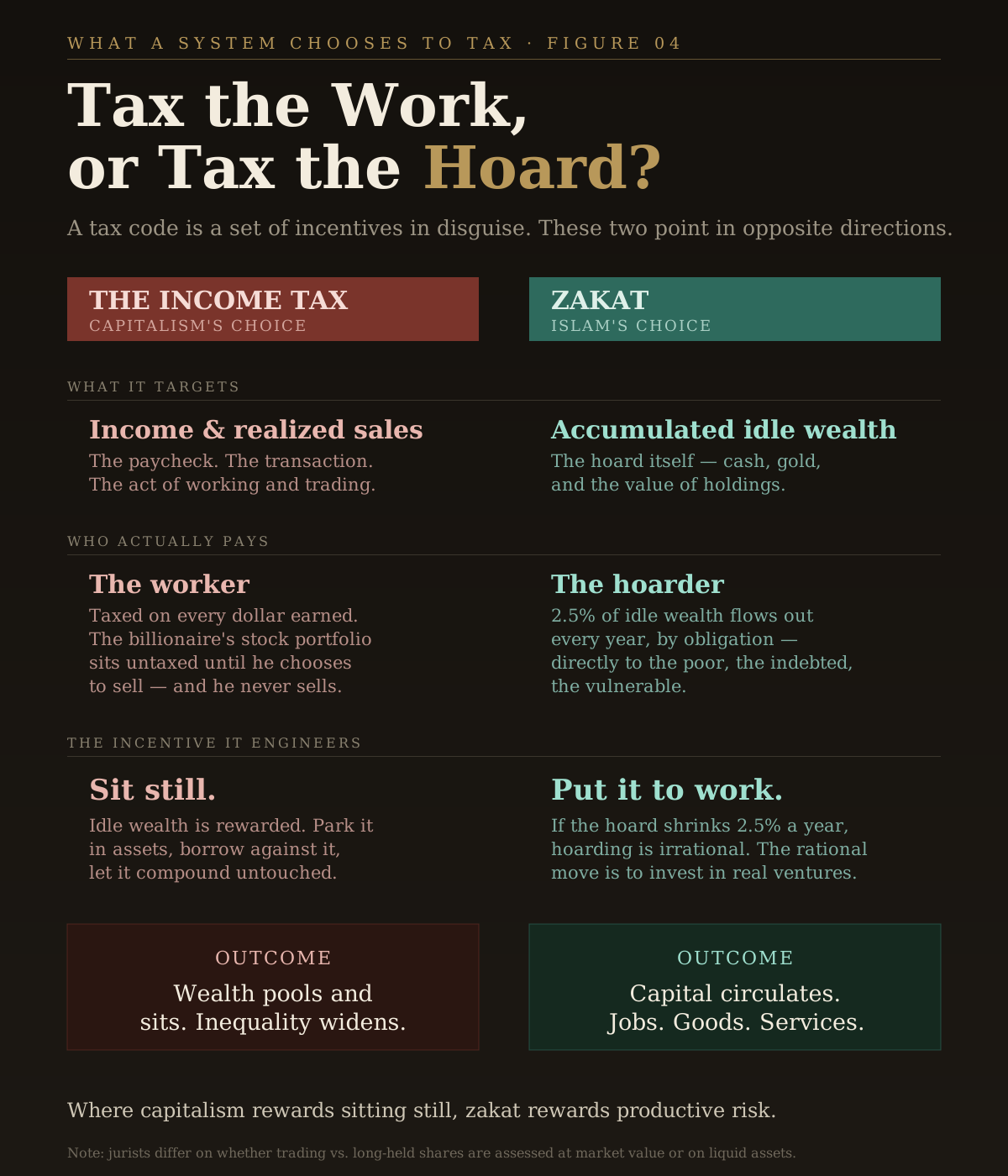
Capitalism taxes the wrong thing. It taxes income and realized sales, which means it taxes the act of working and transacting. The worker is taxed on every paycheck. The shopkeeper is taxed on every sale. But the billionaire whose wealth sits in an appreciating stock portfolio pays nothing until he chooses to sell, and the truly sophisticated never sell. They borrow against the assets (tax-free), live on the loan, and pass the holdings to their heirs on a stepped-up basis. The system is built to let static wealth sit and compound untaxed while taxing the motion of everyone below it.
Zakat inverts this completely. It is not a tax on income or sales. It is a 2.5% annual levy on accumulated, unused wealth, on the hoard itself. Cash, gold, and the liquid value of investment holdings are assessed every year and 2.5% flows out, by obligation, directly to the poor, the indebted, the traveler, and the vulnerable.
The genius is in the incentive it creates. If idle wealth shrinks by 2.5% every year, hoarding becomes irrational. The rational move, the move the system engineers, is to put that capital to work: into real ventures, real production, real partnerships that generate jobs, goods, and services. Wealth is pushed off the sidelines and into circulation. Where capitalism’s tax code rewards sitting still, zakat penalizes it and rewards productive risk.
A point of precision, because the scholarship matters and overclaiming would be its own kind of riba: the exact basis for zakat on shares is debated in Islamic jurisprudence. The mainstream position of major bodies (AAOIFI, the International Islamic Fiqh Academy) is that stocks held for active trading are assessed at full market value, while stocks held long-term are assessed on the investor’s prorated share of the company’s liquid, zakatable assets. Either way the principle stands, and stands against capitalism: idle financial wealth is taxed annually, every year, in a way the “defer until you choose to realize” model never touches.
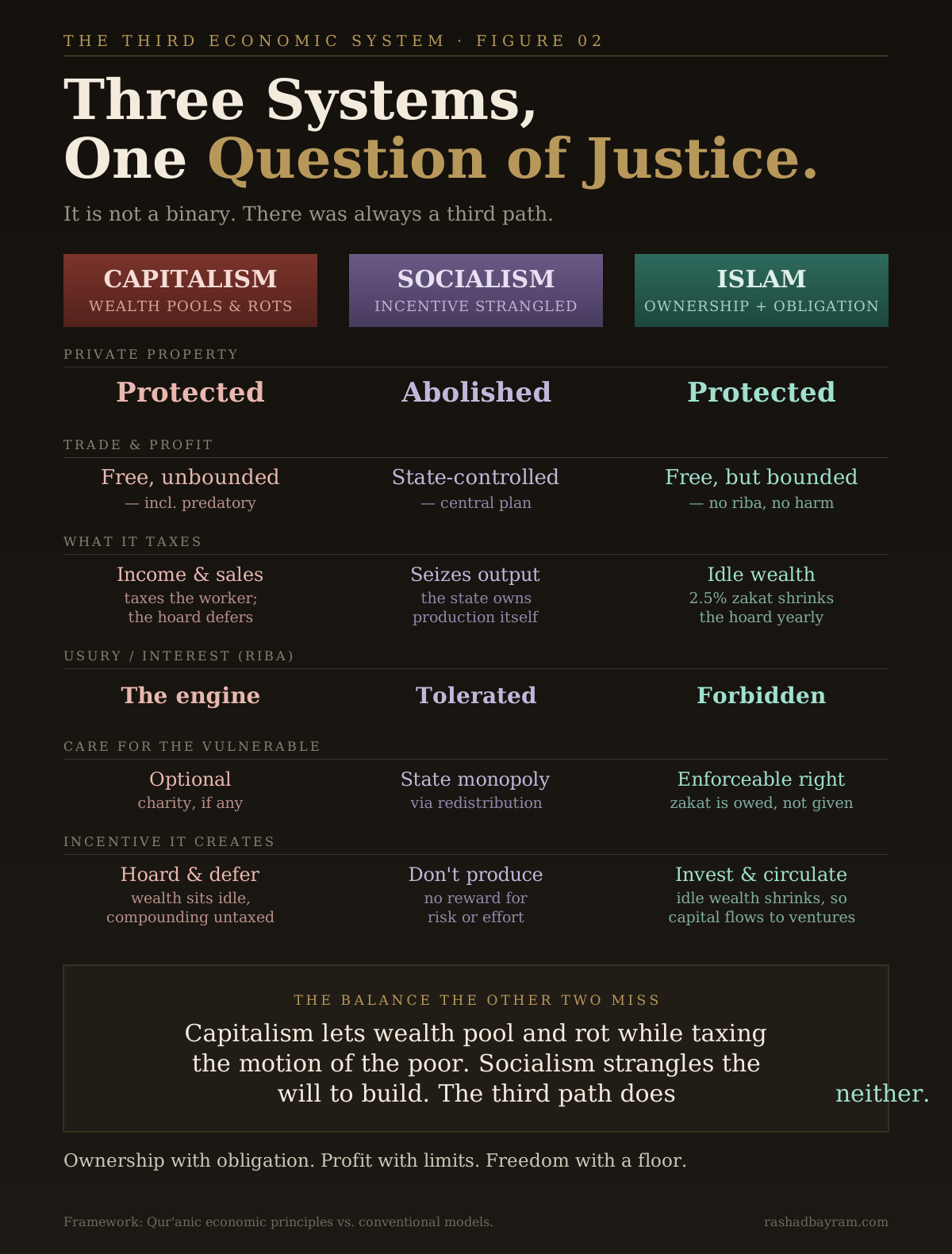
This is the balance the third system strikes and the other two miss. It is not socialism, it protects private property, inheritance, trade, and profit absolutely; it does not confiscate the means of production or flatten incentive. It is not capitalism, it refuses to let wealth pool untaxed and inert while the poor have no enforceable claim on it. It protects the individual’s right to build and guarantees the community’s right to a share. Ownership with obligation. Profit with limits. Freedom with a floor.
And it goes further than redistribution. It forbids the sinful and the predatory as a matter of law, not preference: no usury, no market manipulation, no price-fixing, no gambling, no profiting from pornography or intoxicants. It draws a line capitalism refuses to draw, that not every profit is a legitimate profit, and that an economy is a moral order, not just a price signal.
Part Five: The hardest question, answered head-on
So if the principles are this sound, the honest critic asks the only question that really lands: why are so many Muslim-majority countries poor, authoritarian, and underdeveloped today?
I won’t dodge it, because the answer is the thesis.
Because almost none of them actually run this system. They run conventional, interest-based banking. They run fiat debt-money like everyone else. Their zakat collection is patchy, under-enforced, and often siphoned. The “Islamic finance” many of them practice is conventional debt dressed in Arabic terminology, riba with a costume, a critique made most sharply by Islamic economists themselves. You cannot indict a system that has not been implemented. Pointing at these economies to disprove Qur’anic economics is like pointing at a country that taxes nothing and jails dissidents to disprove democracy.
Because of the oil curse. After 1973, petro-revenue let many states fund themselves without taxing their citizens, which severed the accountability link between government and people, entrenched authoritarianism, and smothered the productive, diversified economy the Islamic model actually requires. Rentier states are a violation of the system, not an expression of it.
Because of colonial rupture. European empires dismantled the waqf and zakat institutions that had run education, healthcare, and welfare for centuries, and restructured these economies for extraction. The historical machinery of Islamic economics was deliberately broken, then its absence blamed on Islam.
And here is the empirical anchor: a 2022 study spanning 49 Muslim-majority countries (2007–2019) found that underdevelopment correlates with restricted economic freedom, rentierism, political instability, and weak knowledge creation, not with Islam. The diagnosis points at the abandonment of the principles, not the principles.
I’ll even engage the sharpest version of the objection honestly. Critics like to draw a clean line: secular Muslim states stable, Islamist ones in crisis. But the line doesn’t hold. Take Türkiye. The pre-Erdoğan, militantly secular republic was less industrialized, heavily dependent on the West for everything from energy to capital, and no stranger to lira crises and devaluation, its industrial base had been foreign-controlled since the Capitulations. Under Erdoğan, whatever one makes of his politics, the country’s GDP grew roughly six-fold to $1.3 trillion, income per capita more than quadrupled, poverty fell from over 20% to under 8%, and it built a sovereign defense industry that now exports drones and military hardware to some 180 countries, emerging, in the words of its own rivals, as a genuine regional power. That is the opposite of the “secular good, Islamic bad” cartoon.
But here is the part that matters for this argument, and the honesty it requires. Türkiye is neither a clean proof of the Islamic model nor a refutation of it, because it doesn’t yet run the model. Its recent bout of world-beating inflation came from monetary mismanagement, forcing interest rates down by decree while prices climbed, not from Islamic economics, which Türkiye has not implemented. What is striking is the direction of travel: Erdoğan now openly calls the global interest-based system structurally broken and “unsustainable,” names Islamic finance as “our exit out of this system,” and is positioning Istanbul as a hub to rebuild, slowly, the interest-free architecture that existed before 1854. A major rising power is publicly reaching back toward the third system. Whether it arrives is another question, but it is reaching toward the right target, not away from it.
The deeper truth still stands, and it is stark: the full system, riba-free, zakat-driven, asset-backed, ethically bounded, has essentially never been implemented at national scale in the modern era. Iran and pre-reform Saudi Arabia, the theocratic cautionary tales critics cite, don’t run it either; oil-rentier states are a violation of the model, not an expression of it. The system hasn’t failed the test. It hasn’t been given one.
What was tested, the early caliphal economy at its disciplined height, produced results worth remembering. Classical chronicles record that under Umar ibn Abdul Aziz, zakat revenue eventually ran short of eligible recipients: officials reportedly struggled to find poor people to receive it. Treat that as the traditional account it is, not an audited statistic, but note that modern economic history independently documents the early Islamic period as one of genuine, broad-based prosperity, with unskilled wages measurably above subsistence across the Abbasid heartland (Pamuk & Shatzmiller, Journal of Economic History). When the principles were practiced, they worked. When they were abandoned, under war, under oil, under empire, they stopped. That is not a coincidence. It is the whole argument.
The Shariah they don’t want you to know
Put the pieces together and the picture is hard to unsee.
The West runs a debt-based monetary system its own central banks admit is built on money conjured from nothing, mathematically guaranteed to concentrate wealth upward and seize in periodic crises. It taxes work and exempts the hoard. It produced $315 trillion of debt and asks the worker to service it. And in the few places it wants genuine results, venture capital, crisis-resilient banking, low-leverage investing, it quietly switches to Islamic mechanics and pretends it invented them.
Islam offers the third path the binary was built to hide. Not capitalism, which lets wealth pool and rot while taxing the motion of the poor. Not socialism, which strangles the incentive to build. A system that protects property and punishes hoarding, honors profit and forbids predation, guarantees the individual’s freedom and the community’s floor, and aims money back at production instead of letting it breed, untouched, on money.
No model built by human hands is perfect. But the principles, justice in exchange, risk shared honestly, wealth kept in motion, the vulnerable given an enforceable claim, are not a relic. They are a live, working blueprint that the most sophisticated corners of modern finance keep validating in spite of themselves.
The Ottomans proved it by dying when they abandoned it. The United States is proving it by drowning in the thing it was built to forbid.
That is the Shariah they don’t want you to know.
References
- Bank of England (2014). Money Creation in the Modern Economy. Quarterly Bulletin 2014 Q1.
- Hasan, M., & Dridi, J. (2010). The Effects of the Global Crisis on Islamic and Conventional Banks: A Comparative Study. IMF Working Paper No. 10/201.
- Institute of International Finance (2024). Global Debt Monitor (global debt ~$315 trillion, Q1 2024).
- Eldem, E. Ottoman Financial Integration with Europe: Foreign Loans, the Ottoman Bank and the Ottoman Public Debt.
- Rogan, E. The Arabs: A History.
- Pamuk, Ş., & Shatzmiller, M. (2014). Plagues, Wages, and Economic Change in the Islamic Middle East, 700–1500. Journal of Economic History.
- Kuru, A. T. (2019). Islam, Authoritarianism, and Underdevelopment: A Global and Historical Comparison. Cambridge University Press.
- Atlantic Council (2025). Why the US Cannot Afford to Lose Dollar Dominance (exorbitant privilege; petrodollar).
- Standard Chartered (2025). Islamic Banking for Financial Institutions: Unlocking Growth Amidst Global Shifts (Islamic finance assets $5.5T to $7.5T).
- Lee, H. (2024). On the Instability of Fractional Reserve Banking. University of Missouri.
- AAOIFI / International Islamic Fiqh Academy, rulings on zakat assessment of shares.
- Study on Muslim-majority development (System-GMM, 49 countries, 2007–2019).
- World Bank (2024). Türkiye Overview (GDP growth, poverty reduction, per-capita income).
- Turkish Exporters Assembly / Anadolu Agency (2024). Türkiye defense exports data ($250M in 2002 to $7.15B in 2024).
- Daily Sabah / Bloomberg (May 2025). Erdoğan remarks at the 2nd Global Islamic Economy Summit, Istanbul (faizsiz ekonomi; Islamic finance as “exit out of this system”).
If this argument lands and you want to see risk-sharing capital in practice, I maintain a free, global directory of funding organizations, with the widest coverage anywhere of halal and Sharia-aligned funds for founders, alongside conventional VCs, accelerators and grants.
Internal references: What Is Riba? · Why Is Riba Haram in Islam? · Islamic Finance: The $5.5 Trillion Model · Bitcoin as Halal Finance and the $1.9 Trillion Proof · The Global Startup Funding Directory