
The short answer: An affordability check that still dumps 100% of the downside on the borrower is not risk management, it is risk dumping. Risk-sharing is not about the loan turning a profit; it is about the financier sharing your downside so its incentives align with your success, and working versions already exist for homes (diminishing musharaka), cars (leasing), and education (income-share agreements). Even mainstream economists like Mian, Sufi, and Shiller designed risk-sharing mortgages to prevent the foreclosure cascades that debt-dumping causes.
Here is a question that sounds simple and quietly dismantles how modern lending works:
If a bank verifies your employment, your income, and your history, and concludes that you can repay, then structures the loan so that you carry 100% of the downside, what exactly was the affordability check for?
If the bank is genuinely confident, why does it need to be fully insulated? And if it needs to be fully insulated, how confident is it, really? A rigorous check that still dumps the entire risk on the borrower is not risk management. It is risk dumping dressed up as prudence.
When I made this argument, the sharpest pushback I got was this: sure, that works for startups, because a startup can generate a profit the investor shares in. But a home doesn’t return a profit. Neither does a car. So risk sharing doesn’t apply.
It is a reasonable-sounding objection. It is also exactly backwards, and the data on why is remarkably clear.
The objection confuses the profit with the point
The argument for risk sharing was never “the lender should get a cut of your profit.” It was “the financier’s outcome should be tied to your outcome.” Those are different claims, and the second one does not require the loan to fund a money-making venture.
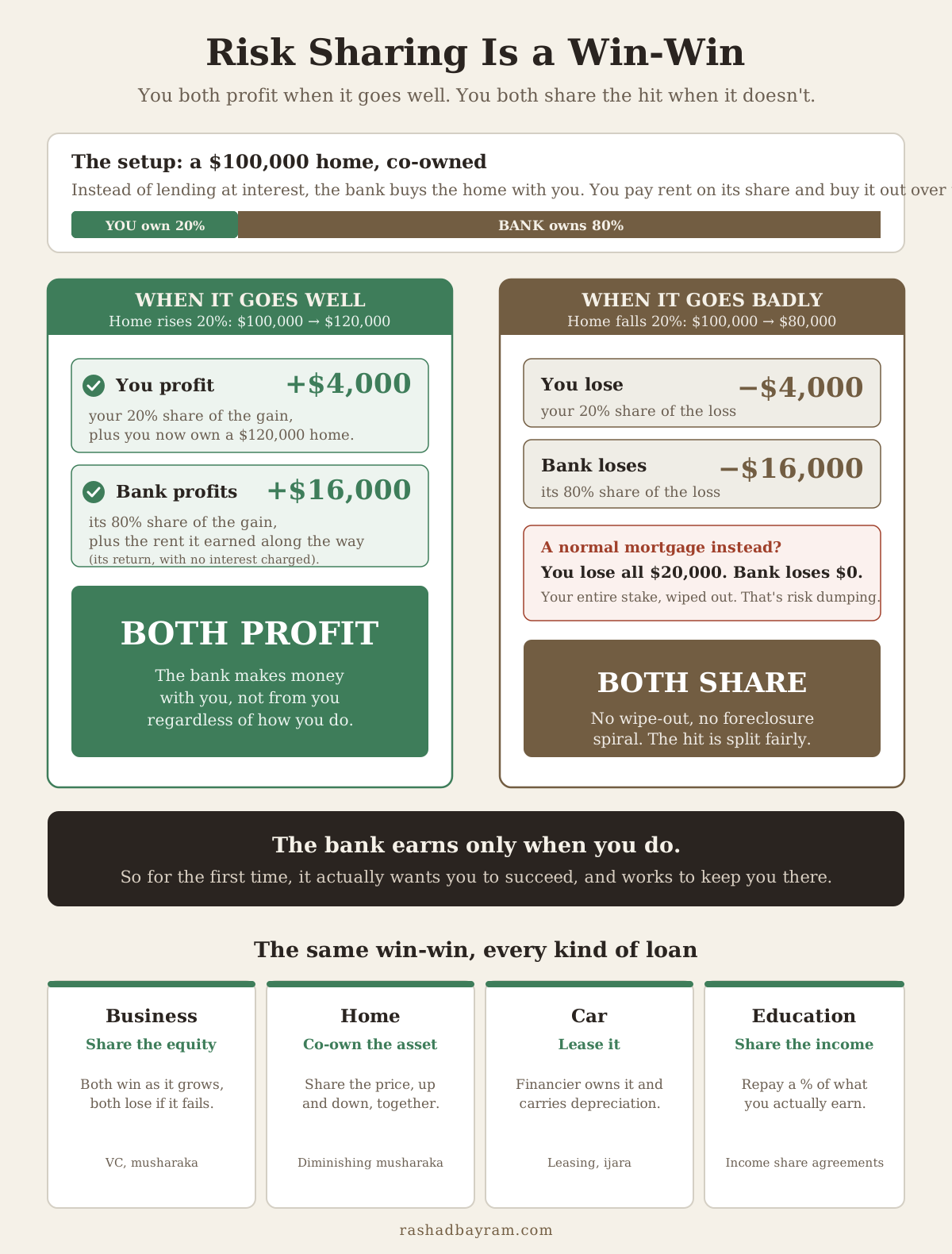
Risk sharing is not one contract. It is a spectrum of structures, and the right one depends on what is being financed:
- Financing a business? Share the equity. The financier wins when the business wins and loses when it loses. This is venture capital, and it is musharaka and mudaraba in Islamic finance.
- Financing an asset like a home or a car? Share the asset’s value. The financier’s stake rises and falls with the price of the thing, not with a business profit.
- Financing a person’s future income, like education? Share the income outcome. The financier is repaid as a share of what the person actually earns, and is repaid less if they earn less.
The commenter was right that a mortgage is not identical to a VC deal. He was wrong that this kills the idea. Every category of loan has a working risk-sharing version. Some are centuries old. Some were designed by Nobel laureates. Let’s go through the evidence.
First, name the disease: levered losses
To see why the current model is risk dumping, you need the mechanism, and the cleanest description comes from two mainstream economists, Atif Mian and Amir Sufi, in their book House of Debt.
Their central finding: the defining feature of debt is that the borrower bears the first losses. Their own example: buy a $100,000 home with an $80,000 mortgage, and your equity is $20,000. If house prices fall 20%, you lose your entire $20,000 investment, while the mortgage lender is untouched (House of Debt, University of Chicago Press).
The lender wrote the loan against a home it was confident about, then arranged things so that a 20% dip erases the buyer completely and leaves the lender whole. That is the affordability-check paradox in one line.
Now scale it up. Mian and Sufi show the distribution is brutal. In 2007, the bottom 20% of American households held almost all their net worth in home equity, with a debt-to-asset ratio around 80%. The top 20% held almost all their net worth in financial assets, with a debt-to-asset ratio around 7% (summary). Debt is structured so the least wealthy are wiped out first, before the protected lenders take a scratch.
This is not an accident of the 2008 crisis. It is the design. And the crisis showed the cost of that design at scale: lenders began foreclosure on nearly 1.3 million properties in 2007, a 79% jump over 2006; more than 2.3 million faced foreclosure in 2008; by February 2009, an estimated 8 million American homes were at risk, and around 8.8 million borrowers were underwater (Subprime mortgage crisis). When the first-loss piece belongs entirely to the households with the least cushion, a price dip becomes a foreclosure wave becomes a demand collapse. Mian and Sufi’s whole thesis is that this transmission, not the banks alone, is what turned a housing correction into the Great Recession.
Ten questions to ask before the money moves
Real cases where the problem was not the one anyone named, the questions that would have caught them, and what a dodge sounds like. Free, and you join the weekly letter. Confirm the link I send and you are in. Unsubscribe any time.
“You can’t share risk on a home.” You already can.
Here is the part that ends the debate: risk-sharing home finance is not a thought experiment. It exists, in two independent traditions that arrived at nearly the same design.
Islamic finance: diminishing musharaka. Instead of lending you money at interest, the bank co-buys the home with you. You own part, the bank owns part, and you gradually purchase the bank’s units until you own it outright, paying rent on the portion the bank still owns. Critically, loss follows ownership. If the property has to be sold at a loss, that loss is shared in proportion to each party’s stake at the time, unlike a conventional mortgage where the lender is fully protected and the owner absorbs everything (Try Barakah, Guidance Residential). The bank has an ownership stake in your home doing well.
Secular economics: the same idea, from the top of the field. In House of Debt, Mian and Sufi propose the shared-responsibility mortgage: if house prices in your area fall 20%, your mortgage principal automatically falls 20%, so you never go underwater and your payments drop. To compensate the lender for taking that downside, the lender receives 5% of any capital gain when you sell or refinance (Equitable Growth). Downside shared, upside shared. That is a win-win by construction.
Nobel laureate Robert Shiller proposed the continuous workout mortgage, where the loan balance and payments are indexed to a local house-price index and adjust downward to prevent negative equity, essentially building the workout into the contract so no one has to foreclose to trigger it (Yale Cowles Foundation). Shiller has spent years asking why housing finance is “still stuck in such a primitive stage” (American Economic Review) and pointing at exactly this: the risk allocation is medieval.
Two of the most respected economists alive looked at the 2008 wreckage and independently concluded that mortgages should share the borrower’s downside. This is not a fringe religious notion. It is the mainstream diagnosis that never got implemented because the current model is extremely profitable for the party that carries no risk.
“But a car? A student loan?” Those have risk-sharing versions too.
The car objection is even weaker, because the mainstream already does it. It’s called a lease. When you lease, the finance company owns the vehicle and bears the residual-value risk: if the car is worth less at lease-end than they projected, they eat the difference. That is sharing the depreciation risk of a depreciating asset. Islamic finance formalizes the same structure as ijara, where the financier owns the asset and carries the ownership risks a pure lender never would.
Even financing a person’s future has a risk-sharing model: the income share agreement. Instead of a fixed-interest student loan, the student pays a percentage of their actual future income for a set term, and payments pause entirely if their income falls below a threshold (RAND). If the graduate earns little, the funder earns little. The risk of a bad outcome is shared, not dumped. (ISAs are lightly regulated and can be structured badly, which is a reason to regulate them well, not a reason the principle is wrong.)
Business, home, car, education. There is a working risk-sharing structure for every one. The objection that “it only works for startups” doesn’t survive contact with the products that already exist.
The real payoff: incentives, not ideology
Here is what actually changes when the bank shares your risk, and it is the whole point.
Today, a conventional lender is senior, collateralized, and often has full recourse. That means the lender is largely indifferent to whether you succeed. It collects interest if you thrive and forecloses to recover if you don’t. In a downturn, foreclosure is frequently the rational move for the lender even when a quiet restructuring would leave the borrower solvent and the neighborhood intact. The lender’s incentive and your survival are not aligned. They are barely on speaking terms.
Flip the structure and the behavior flips with it. A financier who shares your downside is suddenly, urgently interested in your success. It will underwrite more carefully (no more “lend to anyone, the collateral covers us”), it will restructure before it repossesses, and it will act like a partner because it is one. This is not speculation. It is exactly how venture capital behaves: investors share the risk, so they open their networks, coach founders, and fight for the company to survive, because their money dies if it doesn’t. The West has poured roughly $5.5 trillion into startups on precisely this logic, which I break down in Islamic Finance: The $5.5 Trillion Model Proving Why Venture Capital Needs a Rethink.
And when a whole banking system runs on shared risk instead of dumped risk, it is measurably more stable. The IMF studied Islamic banks through the 2008 crisis and found their asset growth held up at more than twice the rate of conventional banks, and none required the taxpayer bailouts that propped up the conventional system (Hasan and Dridi, IMF, 2010). Risk that is shared gets priced carefully. Risk that is dumped gets ignored until it detonates.
Back to the affordability check
So return to the question at the top. A bank runs a rigorous check, decides you can repay, and then builds a contract where a 20% dip in an asset it approved wipes out your entire stake and leaves the bank whole. If it truly believed the check, it would be willing to share the outcome. The fact that it insists on carrying zero risk while charging you for its “confidence” tells you the confidence was never the product. The interest was, and why Islam bans that interest entirely is the deeper argument underneath this one.
Risk sharing is not charity and it is not exotic. It is what “we believe in you” looks like when it is real: the financier puts skin in your game, wins when you win, and loses something when you lose. Islamic finance built its entire system on it. Venture capital quietly runs on it. The best economists of the last two decades have begged the mortgage market to adopt it.
The only people who benefit from calling it impossible are the ones currently collecting a guaranteed return on your risk.
If you’re a founder looking for capital that shares your risk rather than dumping it, I keep a free, global directory of startup funders, including the widest coverage anywhere of halal and Sharia-aligned funds.
---
References and further reading
- Atif Mian & Amir Sufi, House of Debt (University of Chicago Press): book excerpt · shared-responsibility mortgage summary (Equitable Growth)
- Robert J. Shiller et al., Continuous Workout Mortgages: Yale Cowles Foundation; Shiller, “Why Is Housing Finance Still Stuck in Such a Primitive Stage?” (American Economic Review)
- Diminishing musharaka and ijara home finance: Guidance Residential, Try Barakah
- Subprime mortgage crisis (foreclosure and negative-equity data)
- Income share agreements: RAND research report
- Related: The $315 Trillion Question: Why Islam Is the Third Economic System · What Is Riba? · Bitcoin as Halal Finance and the $1.9 Trillion Proof