
The short answer: Vertical AI agents are specialized AI systems that run an entire business function end-to-end, replacing not just the software but the team that operated it. They’re shaping up to be the next wave of billion-dollar startups: a $300B+ opportunity that mirrors the SaaS boom (which captured 40%+ of all VC over 20 years and minted 300+ unicorns). The winners won’t be generic chatbots, they’ll be founders who own a specific vertical’s data, workflow, and edge cases.
The AI Revolution Is Just Beginning, and Vertical Agents Are Leading the Way
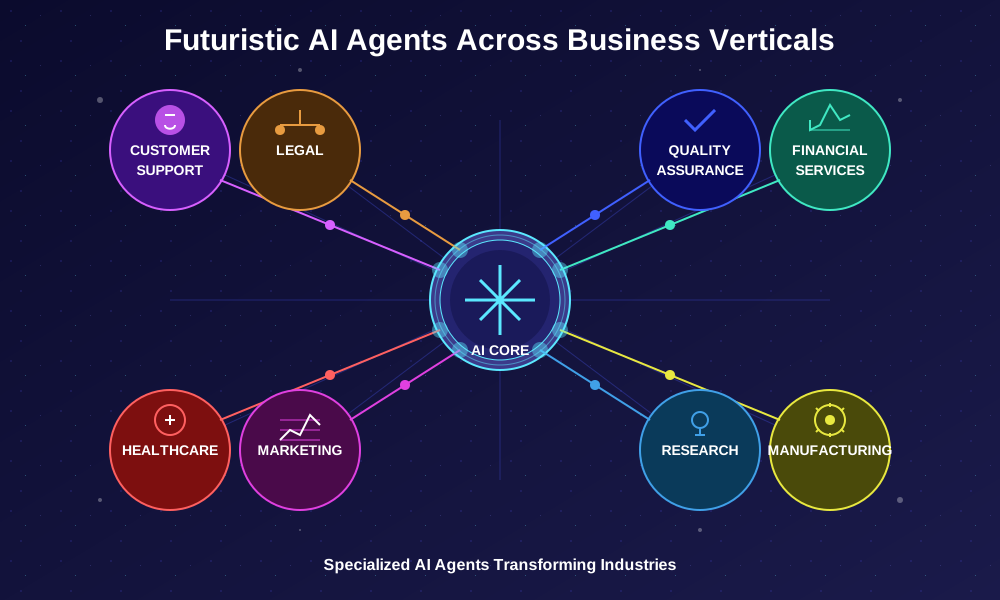
As someone who ran a business and technology consulting agency and has worked with numerous startups and businesses, I’ve noticed a pattern that many entrepreneurs are missing: vertical AI agents which represent one of the biggest opportunities in technology today. While everyone is talking about generative AI and chatbots, I believe we’re about to see hundreds of billion-dollar companies emerge specifically in the vertical AI agent space.
The potential is so massive that we’re looking at a $300+ billion opportunity. That is not just my optimistic projection. It follows Y Combinator’s thesis that vertical AI agents could be 10X bigger than SaaS, which argues there could be 300 billion-dollar companies in this category alone, and it rests on the historical pattern of previous technological revolutions, particularly the SaaS (Software-as-a-Service) boom.
What Are Vertical AI Agents?
Vertical AI agents are specialized AI systems designed to handle complete workflows in specific business domains, effectively replacing both traditional software and the human teams that operate that software. Unlike general-purpose AI assistants, these agents are deeply specialized in particular business functions.
Think of them as AI systems that don’t just help humans do their jobs better – they actually perform entire job functions autonomously, from start to finish.
The SaaS Parallel: History Provides a Roadmap for AI’s Future
To understand the magnitude of this AI opportunity, let’s look at the Software-as-a-Service (SaaS) revolution that began around 2005. Many young founders don’t fully appreciate just how massive the SaaS industry has become:
- Over 40% of all venture capital funding in the last 20 years went to SaaS companies
- More than 300 SaaS unicorns were created in that period
- SaaS fundamentally changed how businesses operate worldwide
The SaaS boom was triggered by a specific technological breakthrough - the XML HTTP request (Ajax) - which enabled rich internet applications in browsers. This breakthrough created an entirely new computing paradigm.
AI is experiencing a similar paradigm shift today.
Large language models represent a fundamental shift in computing capabilities that’s at least as significant as the move from desktop to cloud software. Just as SaaS revolutionized software delivery, AI is revolutionizing what software can do.
Three Categories of Winners in the SaaS Revolution
When analyzing successful companies from the SaaS era, they fall into three distinct categories:
| Category | Description | Examples | Winner Type |
|---|---|---|---|
| Obviously Good Mass Consumer Products | Desktop tools moved to browser/mobile | Docs, photos, email, calendar, chat | Incumbents won (Google, Microsoft) |
| Non-Obvious Mass Consumer Ideas | Entirely new business models | Ride-sharing, food delivery, home-sharing | Startups won (established new markets) |
| B2B SaaS Companies | Specialized business software | 300+ vertical SaaS unicorns | Startups dominated (verticalization won) |
We’re seeing the same pattern emerge with AI, but with even greater potential for disruption and value creation.
Ten questions to ask before the money moves
Real cases where the problem was not the one anyone named, the questions that would have caught them, and what a dodge sounds like. Free, and you join the weekly letter. Confirm the link I send and you are in. Unsubscribe any time.
Why Vertical AI Agents Will Be Even Bigger Than SaaS
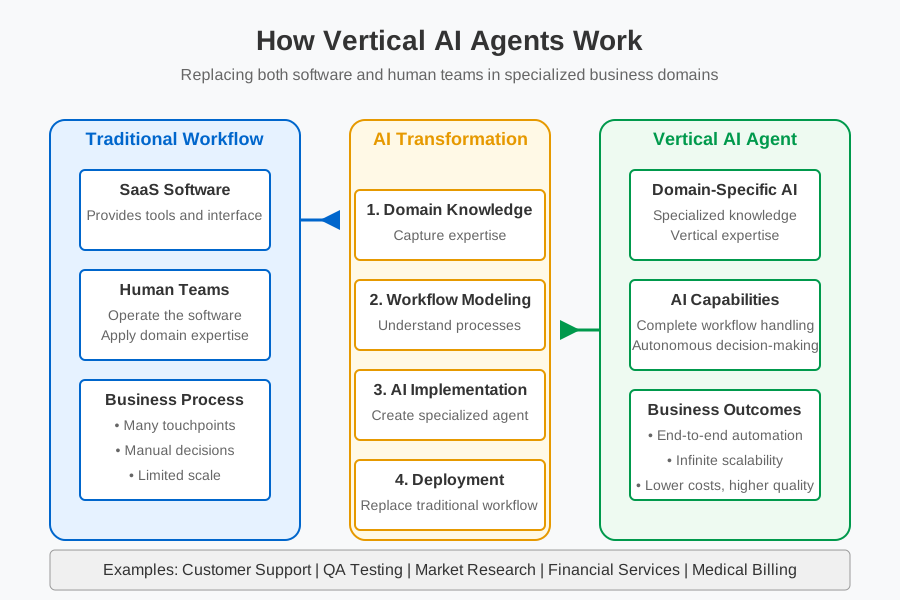
I believe vertical AI agents represent an even larger opportunity than SaaS for three key reasons:
- They replace entire teams, not just software: Companies spend far more on employees than software. AI agents will dramatically reduce headcount needs.
- They eliminate operational friction: SaaS still required humans to operate it. AI agents handle the full workflow.
- They scale infinitely: Unlike human teams, AI agents can scale instantly without quality degradation.
This is revolutionary when you consider the economics. Most companies spend 5-10% of their budget on software but 40-60% on payroll. Vertical AI agents can potentially impact both categories of spending, creating a much larger addressable market than SaaS ever had.
Real-World Examples of Vertical AI Agents Taking Off
The revolution is already happening. Let’s look at some examples of vertical AI agents gaining significant traction:
Survey and Market Research AI
Traditional market research tools required teams to design surveys, analyze results, and derive insights. Now, AI agents can handle the entire process - from survey design to insight generation - allowing product teams to get deeper customer understanding with far less effort.
These AI agents don’t just make existing teams more efficient; they can replace entire research departments while delivering superior results.
Quality Assurance Testing
QA testing has traditionally required large teams of human testers. Now, AI agents can perform comprehensive testing across multiple platforms, identify bugs, and even suggest fixes. Companies using these agents can dramatically reduce or eliminate their QA departments.
The AI doesn’t just run tests - it understands the product functionality, creates test cases, executes them, and reports results without human intervention.
Customer Support AI
While many companies claim to offer AI customer support, most provide simple chatbots. True vertical AI agents in this space can handle complex support workflows including ticket resolution, knowledge base updates, and escalation management. Some are already handling 30,000+ tickets daily, replacing teams of 1,000+ human agents.
The sophistication of these systems goes far beyond basic chatbots - they understand context, apply solution frameworks, and can even detect customer emotions.
AI-Powered Collections
In financial services, teams of agents traditionally call customers with overdue payments. AI voice agents can now make these calls at scale with remarkable accuracy. The technology not only reduces costs but eliminates a high-turnover, low-satisfaction job category.
The AI voice systems are so natural that customers often don’t realize they’re speaking with an AI, leading to higher engagement and better outcomes.
How AI Voice Is Accelerating Vertical Agent Adoption
The rapid improvement in AI voice technology has dramatically expanded what’s possible. Just six months ago, AI voices weren’t realistic enough and had too much latency to replace human calls. Today, they’re indistinguishable from humans in many scenarios.
This progression shows how quickly AI capabilities are improving:
- 2023 (Early): Simple text generation for marketing copy and blog posts
- 2023 (Mid): More sophisticated document analysis and content creation
- 2024 (Early): Complex workflow automation and process management
- 2024 (Now): Full-service vertical agents replacing entire business functions
The acceleration of AI capabilities continues to surprise even industry insiders. What seemed like science fiction a year ago is now commercially available.
The Verticalization Advantage: Why Specialized AI Agents Win
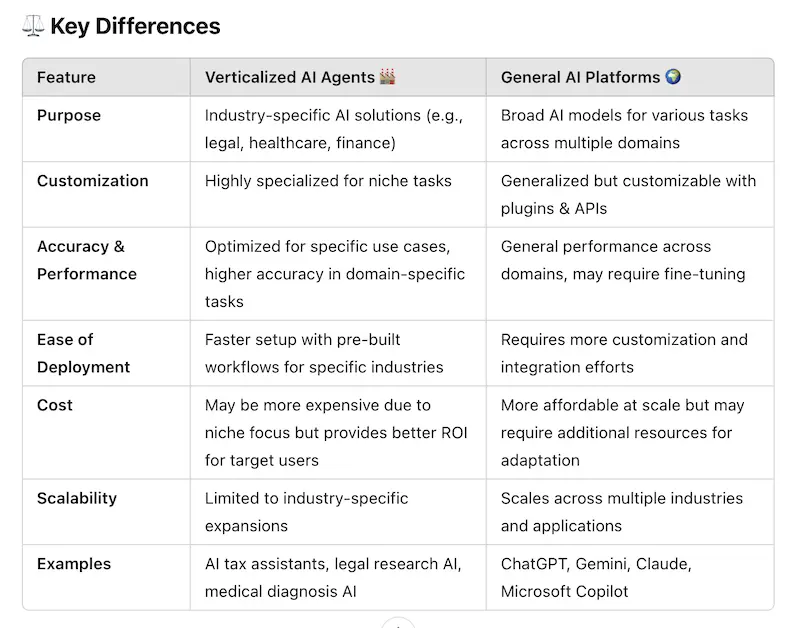
Unlike general-purpose AI platforms, vertical AI agents have several advantages:
- Domain-specific knowledge: They understand industry terminology, regulations, and best practices
- Specialized capabilities: They’re optimized for specific workflows
- Easier sales process: They solve clearly defined business problems
- Higher ROI: They replace entire teams, not just making teams more efficient
These advantages are precisely why we saw 300+ SaaS unicorns emerge instead of just a few dominant players. The same pattern is developing in AI, but with even greater potential for value creation.
Why Incumbents Often Miss These Opportunities
When new computing paradigms emerge, incumbents often struggle to capitalize on them. They’re too focused on their existing business models and don’t have the specialized knowledge required for each vertical.
For example, Google never launched an Uber competitor or an Airbnb clone, despite having the resources to do so. Similarly, major SaaS companies won’t be able to dominate every vertical AI agent category. The opportunity is simply too vast and diverse.
How to Find Your Vertical AI Opportunity
The common thread across successful vertical AI startups is finding boring, repetitive administrative work that can be automated. Here’s how to identify these opportunities:
- Look for “butter-passing jobs” - repetitive tasks no one enjoys
- Find domains you have personal experience with
- Observe existing workflows to identify inefficiencies
- Sell to leadership, not to the teams being replaced
For example, one promising startup began when a founder observed his dentist mother spending hours processing insurance claims - a perfect task for AI automation. Accounting has the same shape, which is why we built a vertical agent for automating the document chase in tax workflows.
Four Questions to Ask When Evaluating Vertical AI Opportunities
- Is the task repetitive and rule-based? These are easiest for AI to handle.
- Does it require specialized knowledge that can be encoded? Domain expertise gives you a defensible advantage.
- Is there significant spending in this category? Look for areas with large teams doing similar work.
- Can you sell to decision-makers above the teams being automated? This avoids resistance from those whose jobs might be affected.
This defensibility question is exactly what investors now press on: AI is a feature, not a company, and the fundable startups are the ones where AI sits inside a moat competitors cannot copy.
The End of Inefficient Scale: AI Is Changing Business Economics
AI is also changing how companies scale. Traditionally, revenue growth required proportional headcount growth. Even successful unicorns often had thousands of employees by the time they reached $100-200M in revenue.
Vertical AI is changing this equation. We may soon see unicorn companies with just 10-20 employees managing AI systems that deliver massive value to customers.
This transformation will create an entirely new category of hyper-efficient businesses that can scale revenue without scaling headcount at the same rate.
| Business Type | Revenue Per Employee | Scale Characteristics |
|---|---|---|
| Traditional Business | $100K-250K | Linear headcount growth with revenue |
| SaaS Business | $250K-500K | Sublinear headcount growth |
| AI-Powered Business | $1M-10M+ | Minimal headcount growth with scale |
Extending Human Capabilities: The Augmentation Opportunity
Beyond just replacing jobs, AI is extending what’s possible for business leaders. CEOs can now potentially:
- Maintain meaningful connections with thousands of employees through AI-mediated communication
- Process and synthesize vastly more information than previously possible
- Make decisions with much broader context
This may even challenge traditional theories about organizational size limitations. As AI extends the “context window” of human managers, companies might be able to grow larger before hitting efficiency limits.
The Vertical AI Playbook: How to Build a Successful AI Agent

If you’re an entrepreneur looking to capitalize on this opportunity, here’s a playbook for developing successful vertical AI agents:
- Start with a very specific vertical: The more specialized, the better your chances of success.
- Build domain-specific knowledge: This is your moat against generalist AI platforms.
- Focus on full workflow automation: Don’t just make existing processes more efficient; reimagine them.
- Sell on ROI, not AI: Customers care about business outcomes, not technology.
- Design for human collaboration: The best systems augment humans rather than just replacing them.
- Continuous improvement: Build systems that get better with more usage and data.
Technical Requirements for Effective Vertical AI Agents
| Component | Description | Importance |
|---|---|---|
| Foundation Models | Base AI capabilities | Critical starting point |
| Domain-Specific Fine-Tuning | Specialization for the vertical | Key differentiator |
| Workflow Orchestration | Managing complex processes | Essential for automation |
| Evaluation Frameworks | Ensuring quality and safety | Critical for adoption |
| Integration Capabilities | Connecting with existing systems | Necessary for implementation |
Conclusion: The $300 Billion AI Opportunity
The pattern is clear: just as 300+ SaaS unicorns were created by specializing in vertical business functions, we’re about to see 300+ vertical AI agent unicorns emerge. These companies won’t just replace SaaS - they’ll be substantially larger because they replace both software AND the human teams operating that software.
For entrepreneurs, the opportunity is immense but time-sensitive. The winners in each vertical will establish data and customer relationship advantages that will be difficult to overcome.
The AI revolution is happening now, and vertical agents are where the biggest opportunities lie.
Key Takeaways About Vertical AI Agents
- Scale: The vertical AI agent opportunity will create at least $300 billion in company value.
- Scope: Nearly every business function will eventually have specialized AI agents.
- Speed: The transformation is happening at unprecedented speed.
- Strategy: Success requires deep vertical specialization, not horizontal platforms.
- Shift: We’re moving from AI that helps humans work to AI that works autonomously.
What vertical business function do you think is ripe for AI agent disruption?
Further reading
- Most AI Automation Agencies Are a Scam. Not for the Reason You Think.: the buyer’s side of this, and why agents fail commercially even when they work technically.