
The short answer: Building reliable AI agents is genuinely hard, most impressive demos break in production, and even Apple and Amazon have stumbled. Before building one, confirm the problem actually needs an agent’s flexibility (not simpler automation), make sure your data is clean and structured, start with low-risk internal workflows, and design agents to augment people rather than replace them. The real wins are in narrow, well-scoped verticals, not generic chatbots.

The Reality Behind AI Agents
While exploring practical use cases and the application of AI agents in real-world businesses, I encountered an X post by Ph.D. in AI, Andrey Burkov. This post provided valuable insights, which coincided with my ongoing contemplation on the potential benefits of AI agents for businesses.
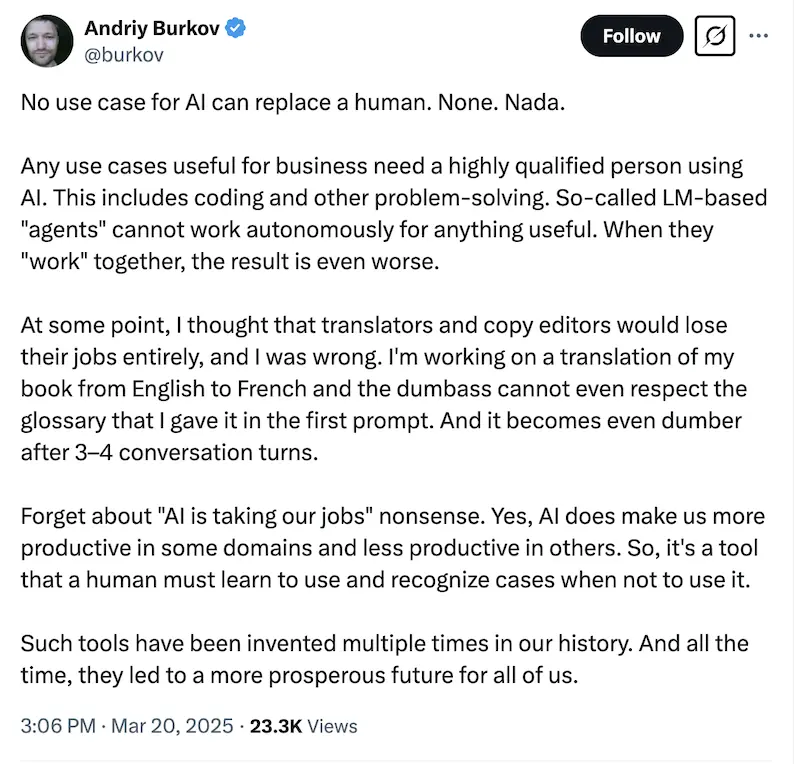
This discovery further strengthened my skepticism regarding the immediate and tangible benefits of AI agents for businesses at this juncture.
While AI agents present significant challenges, they also represent an enormous business opportunity when implemented correctly in specific verticals. As I explored in my previous article $300B AI Opportunity: Vertical AI Agents, Next Generation Unicorns, specialized AI agents are poised to disrupt traditional SaaS businesses by automating entire business functions.
The world is buzzing with talk about AI agents. Yet even tech giants like Apple and Amazon struggle to implement reliable AI agent features. Apple recently had to pull back Apple Intelligence due to hallucinations in its AI agent summarization features, while Amazon still faces challenges integrating AI agents into Alexa.
Despite the hype online countless tutorials, frameworks, and tools for AI agent development the truth remains: building effective and reliable AI agents is extremely difficult. Most AI agent examples you’ll see are impressive demos, but these AI agents often break down when deployed in real-world applications.
This article shares practical tips for business owners and anyone interested in building more effective and reliable AI agent systems.
What Business Leaders Should Consider Before Implementing AI Agents
Before diving into AI agent implementation, business leaders must conduct a thorough assessment of their organization’s readiness and needs. Start by clearly defining the specific business problem you’re trying to solve is it truly a problem that requires an AI agent’s flexibility, or could it be addressed with simpler automation tools? Perform a detailed cost-benefit analysis that accounts not just for initial development, but ongoing maintenance, model costs, and potential retraining as your business evolves. Model pricing keeps shifting, and cheaper open options like DeepSeek reshaping the AI landscape can change those numbers quickly. Evaluate your data infrastructure critically; AI agents require clean, structured data and robust systems that can handle increased computational demands. Consider your team’s capabilities do you have the technical expertise in-house, or will you need to hire or partner with specialists? Implement a staged rollout approach, starting with low-risk, internal applications before customer-facing deployments. Most crucially, establish clear metrics for success and failure conditions before implementation begins, with regular evaluation points to assess whether the AI agent is truly delivering value or if a simpler solution might be more effective. Remember that the most successful AI agent implementations tend to augment human workers rather than replacing them, creating human-AI collaborative workflows that leverage the strengths of both.
Ten questions to ask before the money moves
Real cases where the problem was not the one anyone named, the questions that would have caught them, and what a dodge sounds like. Free, and you join the weekly letter. Confirm the link I send and you are in. Unsubscribe any time.
What Are AI Agents, Really?
If you search for “how to build AI agents” online, you’ll find tutorials that essentially describe software that makes API calls to a large language model (LLM). But is this truly an AI agent?
According to experts, not all LLM implementations qualify as true AI agents. So why is everyone talking about AI agents?
The answer is simple: hype. What do business owners actually need know when building AI agents is automation systems that can take processes and automate them using AI.
A Clear Distinction: Workflows vs. AI Agents
As defined by Anthropic in their blog post How to Build Effective Agents:
- Workflows: Systems where LLMs and tools are orchestrated through predefined code paths
- AI Agents: Systems where LLMs dynamically direct their own processes and tool usage, maintaining control over how they accomplish tasks
Understanding this distinction is crucial for business owners and leaders to know when to use which pattern when designing AI agent solutions with the tech team.
Building Effective AI Agent Systems: The Fundamentals
Step 1: Choose Your AI Agent Development Tools
For developers with coding skills building AI agents:
- Python
- TypeScript
- JavaScript
For those without coding skills looking to create simple AI agents:
When developing AI agents, focusing on specific vertical business functions provides the greatest opportunity for success. In my article The Verticalization Advantage, I explain why specialized AI agents tend to outperform general-purpose solutions.
Remember, the tool itself matters less than the underlying patterns you use to control the flow of your AI agent application and data. For a hands-on look at shipping a real product with these tools, see how I went about vibe coding a SaaS app.
Common Building Blocks for AI Agent Systems
The Augmented LLM for AI Agent Development
The basic building block of any AI agent starts with an LLM and can be enhanced through:
- Retrieval: Pulling information from external sources (typically a vector database) through Retrieval Augmented Generation (RAG) to create more knowledgeable AI agents
- Tools: Small services or APIs that provide additional information (weather data, shipping updates, etc.) for your AI agent to access
- Memory: Past interactions with the AI agent system
When these three components are combined effectively, they elevate your AI agent application beyond a simple ChatGPT wrapper.
AI Agent Workflow Patterns
1. Prompt Chaining for AI Agents
This pattern involves chaining together multiple LLM calls in your AI agent, using the output from one call as input for the next. This approach breaks down complex problems into manageable steps for the AI agent to process.
Example: Rather than asking the AI agent to “write a blog post,” break it down into:
- Research and brainstorm ideas
- Define a specific topic
- Create an outline
- Write each chapter separately
Each step becomes a chain where your AI agent maintains control over both the data and the prompt.
2. AI Agent Routing
When your AI agent problem scope grows and requires multiple solutions, routing comes in. This pattern lets the AI agent categorize incoming requests and direct them to the appropriate workflow.
How it works:
- AI agent categorizes the incoming request (A or B)
- Your application captures this in a structured way
- Control flow uses routers (if statements/case statements) to direct the request to the appropriate AI agent function
3. AI Agent Parallelization
Similar to prompt chaining, but AI agent processes run simultaneously rather than sequentially. This is ideal for independent tasks and can significantly speed up your AI agent application.
Example use case: Implementing guardrails for AI agents that evaluate:
- Accuracy/correctness of AI agent responses
- Harmful content detection in AI agent outputs
- Prompt injections that might compromise the AI agent
All checks can run in parallel and combine results for a comprehensive AI agent guardrail system.
4. Orchestrator-Worker Pattern for AI Agents
This AI agent workflow pattern is slightly more “agentic” as it requires less explicit programming of steps, but remains sequential and predictable for your AI agent.
Example use case: Customer service email processing with an AI agent:
- AI agent analyzes incoming email, CRM data, and order information
- AI agent determines required actions (looking up policies, checking order status, calling shipping API)
- System performs these actions in sequence with the AI agent as the orchestrator
5. Evaluator-Optimizer Pattern for AI Agent Content
This pattern uses multiple AI agent calls to create, review, and improve content.
Example flow:
- AI agent generates content (e.g., a blog post)
- Another AI agent prompt critically reviews the content against specific criteria
- A third AI agent incorporates feedback to improve the original content
The True AI Agent Pattern
Unlike workflows with clear start and end points, true AI agent systems operate in a loop:
- Human makes request to the AI agent
- AI agent decides on an action
- Action is performed in the environment by the AI agent
- AI agent receives feedback
- Process repeats until the AI agent completes the task or meets stopping criteria
This pattern can handle sophisticated tasks with a straightforward implementation, but getting reliable results from AI agents is extremely challenging.
Real-world example: Devin, the AI “software team mate” that received significant hype as an advanced AI agent. Despite its sophistication, reports indicate this AI agent successfully completes only a small percentage of assigned tasks.
Key Tips for Building Reliable AI Agent Systems
1. Be Cautious with AI Agent Frameworks
AI agent frameworks can get you up and running quickly, but make sure you understand everything that’s happening under the hood. You’ll become a better AI agent engineer by building core components from scratch.
2. Start Simple with AI Agent Design
Prioritize deterministic workflows over complex AI agent patterns. Isolate the problem and build your AI agent from the ground up:
- Analyze all the data your AI agent needs to process
- Create a categorization step that selects a small portion of the problem for your AI agent
- Perfect your AI agent solution for that specific case
- Scale horizontally to other problems once you understand the full scope of AI agent capabilities
3. Plan for AI Agent Scale
Don’t underestimate what happens when you move your AI agent from demo to production. The challenges multiply exponentially when your AI agent system faces hundreds, thousands, or millions of users.
Scaling retrieval augmented generation (RAG) for AI agents is particularly challenging as your vector database grows. Be very cautious about deploying AI agent solutions too soon.
4. Implement AI Agent Testing and Evaluation Systems
Start with testing your AI agent from the beginning. Ask yourself: If you were to change your AI agent system prompt right now, could you confidently say it would improve your application beyond a simple gut check?
5. Establish AI Agent Guardrails
Before sending AI agent output back to users, have another LLM check whether the response is appropriate. This simple step is often overlooked in AI agent development, even by major companies.
Learning More About AI Agents
Despite the challenges outlined in this article, vertical AI agents represent one of the biggest opportunities in technology today. For entrepreneurs interested in this space, I recommend reviewing my framework for building successful vertical AI agents, which provides a practical roadmap for development.
Further reading
- Most AI Automation Agencies Are a Scam. Not for the Reason You Think.: the commercial version of this argument, on why automation projects fail even when the build works perfectly.